


The Mod-Navy Qual
I’ve been doing this qual (or drill, or whatever the current nom de guerre is for graded shooting), or some variation of it for almost 20 years. Personally, as well as using it for an organizational benchmark and gear/carbine set up shakedown. I’ve come to view it as the barbell deadlift of the fighting carbine. If you don’t understand that reference, get your ass to a barbell gym and get a coach ASAP.
This is what I mean: To the untrained eye, this drill is pretty simple (i.e., just bend over and pick the bar up). However, there’s a lot going on here amalgamated into one dose, and unless you want to pick up the shattered pieces of your ego along with your brass at the range, you need to understand and apply rapid basics that are almost perfectly executed.


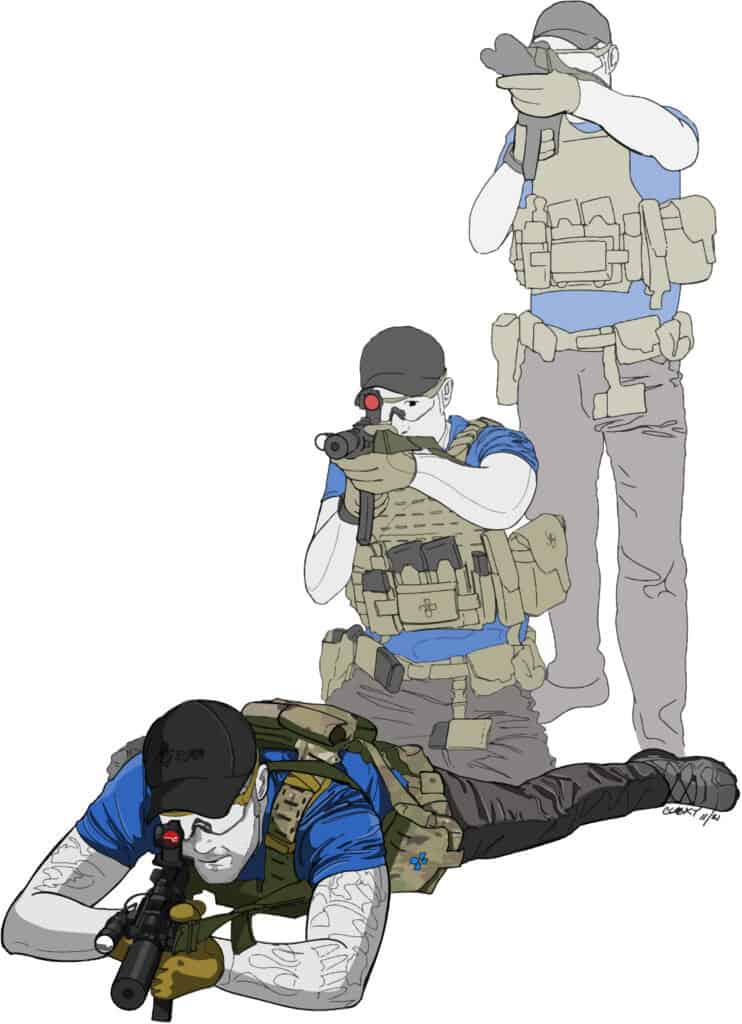
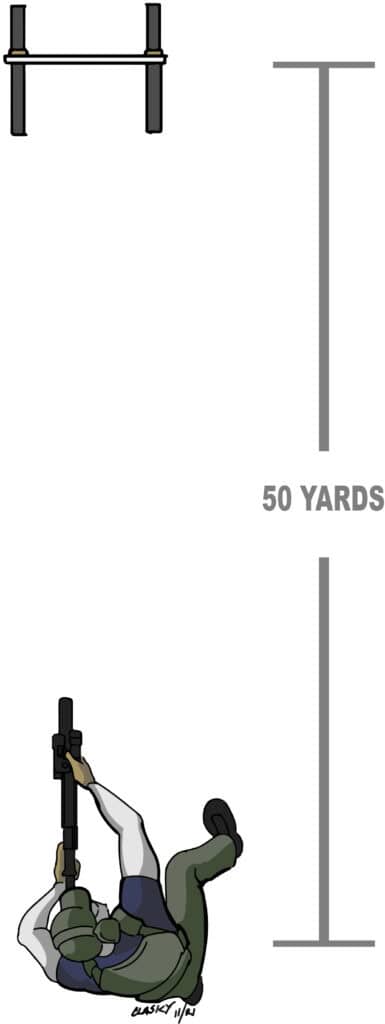
The Qual is simple. Your target is an 8-inch circle at 50 yards. Your loadout is three magazines of five rounds each. Your firing sequence on the buzzer is five rounds from the standing, speed reload, five rounds from an intermediate position, speed reload, five rounds from the prone.
Let’s break this thing down piece by piece.

The Name
We can all thank Jeff Gonzales from Trident Concepts for bringing this into the light in the very early 2000s. However, Pat Rogers from EAG Tactical saw its value and did a lot of the heavy lifting in proliferating the drill as great benchmark and skills formulation exercise. How did this drill become popular in some Army SOF circles, even with “Navy” in the name? Pat.


The Standing
Starting from the “ready” position of your choice, on the buzzer get that reticle settled inside the 8-inch circle and squeeze the trigger five times. Doing this without maintaining constant contact on the trigger will have disastrous results. “Press to reset” is the way; I don’t care what the internet says. The other factors of Stance, Grip, and Sight picture all have to be there in order to get this done in a rapid cadence. From an instructor’s point of view, this is when one can literally hear all the components of good shooting coming together. It sounds a lot like about a .35-.50 split time continuously with no breakdown during the five-shot string.
A lot of shooters who lack the skills necessary to do that will have a rapid first two rounds, then a long break, then a single, then two more erratically spaced rounds. That’s all indicative of little to no recoil control, follow-through, a gross standing off-hand shooting position, and probably a fair amount of trigger rape. Not to mention those rounds not being inside the target area. Pro tip—if you have a two-point adjustable sling, size it for your weapon and your body and use it for this drill as a stability aid. Having five points of contact on the gun makes for faster and more accurate shooting.
Additional pro tip—your standing position should not be formed toward “absorbing” recoil. We need to transfer that shit into the ground as efficiently as possible so the reticle doesn’t move around as much during follow-through. Having a straight, or near to it, strong-side leg to the rear will greatly aid that recoil transfer.
The Reload
As soon as you get tactile (feeling it) feedback in your face that the bolt has locked back to the rear, do “your” thing with the speed reload. If as much fat as possible isn’t already cut out of “your” thing, then you will find that “your” thing may be sub-optimal. Frenetic movement and straight lines are your biggest enemy and greatest friends, respectively. Pro tip—do this as you are transitioning from a standing to an intermediate position. No reason to conduct it fully from standing, then start moving into the next position.
The Kneeling (Intermediate)
I’m gonna start this off with a little bit of a rant, but it needs to be said. I term any position that gets you about half as tall as you are an “intermediate” position. Whatever gets that done is acceptable here. The presence of actual knees on the ground is irrelevant. I’ve worked with too many agencies and organizations who, for some reason, mandate that one or both knees have to be on the ground for a position to “count” or “be authorized.” This is stupid. If the position is the same as far as vertical height goes, and the shooter can get into it, shoot from it, reload from it, and get out of it all with the time and or efficiency required, then what does it matter? Ok, rant over.

All the same raw shooting points brought up above are in effect here, and again you might find that “your” preferred intermediate position might be less than optimal. Typically, this is due to shooters thinking that Stability is the key component. I concede that it’s important, however I will put forth that recoil management and follow through are more important. There are many intermediate positions that are stable, until you press that trigger, then it takes an eternity for that reticle to fall back where you need it for follow up shots because those positions don’t lend themselves to exceptional recoil management. Your ability to deliver a single accurate shot is irrelevant here, we need 5 as fast as possible, and all of them accurate (enough). And oh yeah, conduct that second reload in the midst of going down into prone.
Pro Tip – Monica, also known as double kneeling to the church going crowd is almost universally the answer here. I have seen shooters use braced or speed kneeling effectively, but not many. The capability of the Monica position is that nothing has changed from your waist up from when you are shooting standing. So it goes to reason that if you can deliver rapid accurate rounds from standing, then no need to change anything at all besides dropping down to both knees and doing it again. It also has the bonus of keeping your support equipment (magazines, pistol, med kits) all in the same orientation respective to your arms and torso as the standing position so any skills you have developed manipulating those things will still be present with no movement modifications needed at all. Both of these things equate to efficiency, which is in dire need here.
The Prone
This, believe it or not, is the biggest hang up for a lot of shooters. Why? I think it’s primarily because A LOT of shooters are mentally hardwired that prone equals slow shooting for administrative zero purposes, or just extreme accuracy (8 inches at 50 yards is in no way extreme folks) and they have never trained a prone position, or just shooting from prone that is both fast and accurate. Let the wheels come off some at this point. Get down into prone, anchor that goddamn gun to the ground and to you (your support side hand and sling should be doing a lot work here) put that reticle where it needs to be, and press that trigger five times. If the gun is anchored, those hits will be there.
When it comes to the prone position, again, you can pull off a single accurate shot from any F’ed up position you want assuming you put the reticle where it needs to be and process that trigger without disturbing said reticle. The fork in the road is when we need to do that 5 times as rapidly as possible while still maintaining the necessary accuracy component. That changes things. And may change “your” prone. Pro Tip – wear gloves always when working a carbine or pistol hard. Adult males turn into pathetic creatures when their little hands get cut, punctured, torn, blistered, etc. and then the weapon is in charge. Wearing gloves gives you the ability to post out into prone (or working any barricade or whatever) without trying to consciously or subconsciously minimize damage to your hands, it will also make sure that you stay in charge of that potentially hot and / or sharp hunk of metal that launches bullets that your hands need ultimate and tyrannical control over.
The Scoring
Here is where me and Jeff and Pat differ. I use a 25 second par time, and only clean runs count. I.E. 15 hits inside the 8 inch circle. You can You Tube search “mod navy qual” and see a video that Jeff G. did over a decade ago where he explains the scoring algorithm to determine a hit factor and different levels of expert, intermediate, shitty, etc. Don’t get me wrong, all that is great but the mindset I want in doing this drill is “only hits count, and they need to be as rapid as possible”. That’s all. No varying levels of acceptability to be found. What’s passing? 25 seconds or less clean. What if I can do it 21 seconds clean? Then great job! Now you can start working on other, less foundational skills like shooting off hand from your support side or Hondo rolling over a barrel while transitioning to your secondary fixed blade and tomahawk simultaneously. I have no issues with what I call “Majoring in the minors” assuming your constant pull skills for running the gun are up to snuff. After that, have it. Sadly a lot of shooters don’t have those foundational skills they can pull from while attempting other things that are really just minor deviations to what should already be unconsciously competent skills.
I have used the Mod Navy Qual to shake myself and my gear as a system out (this drill was what shitcanned the SCAR-H as a viable option for us but that is a different story), as well as assess baseline foundational skills necessary to run the gun in a team, and finally as the first time on a flat range we can tie a modicum of thinking, and moving, and shooting together into one graded event. When broken down into its component parts it can really highlight where deficiencies are, and why they might be there. It was the first drill that needed to be passed in order to demonstrate that there is not much left to teach this person at the 50 yard line and we were ready to move on with those skills and actions present for additional use under varying contexts and conditions. All the mechanics need to be there and demonstrated under a bit of pressure in order to get that 25-second or less clean run in order to pass. One flubbed reload, or skitter step while transitioning positions, or pull of the trigger when the reticle wasn’t settled – and you’re probably out. Adjust skills and techniques as necessary, try again. Pick of pieces of ego along with brass. I’ve picked up more ego off the deck than I have brass over my career, so can we all. Text by Chris Sizelove
About The Author
Chris Sizelove retired as a Master Sergeant from the United States Army after twenty years of service. He served sixteen years in the 75th Ranger Regiment followed by four years with the Defense Intelligence Agency. While in the Ranger Regiment, he became both a subject matter expert and instructor for carbine, pistol, CQB, assault, joint operations, and forced entry methods. He served as a sniper and a Senior NCO of a Joint Reconnaissance Platoon. In the role of the 75th’s Master Breacher, he led both training as well as R&D for forced entry of all types. Chris also propagated and instructed covert carry and vehicle TTP’s for specific roles within the Regiment as well as the Defense Intelligence Agency. Text by Chris Sizelove