Shoot This Drill – The Dirty Diamond
Drills. We use that word universally in the firearms training world. Before I lay out today’s drill, let’s first define it, as well as give you my own personal philosophy on the purpose and structure of a drill.
The closest dictionary definition of the word “drill” that most closely relates to firearms training is something to the effect of “intense or structured training, typically by means of repeated exercise.” I don’t think that definition fully expresses how we use the word “drill” in the context of firearms training.
Typically, a drill is a repeated exercise that involves a set pattern of movement, order of target engagement, and has an accuracy standard or time AND accuracy standard (i.e., Hit Factor in USPSA, points divided by time) associated with it. The drill will focus on a particular skill or combination of skills and is designed to develop and measure proficiency in those skills.

I believe that there is merit in designing a drill that narrowly focuses on a specific skill, but I also believe—especially for units, departments, organizations, that have limited training time—there are solid reasons for designing drills that can incorporate multiple skills which are executable under a variety conditions. Unlike a USPSA Classifier, I also like drills that possess a certain versatility that allows them to be scaled and modified based on the needs of the individual or organization.
A drill might have a specific set of time and accuracy standards associated with it. For example, the designer of the drill might establish a standard that must be met to be considered an “expert” or “advanced” at that drill, and practitioners will spend countless hours chasing an arbitrary standard. I understand the feeling of accomplishment one might have once that standard is met, and even more so once it is able to be met consistently on demand. However, once the standard is met, do serious shooters then determine they are “good enough,” or have they simply moved the goal post and attempt further progress beyond the established standard?
The drills and exercises I use for my students in class don’t have any specific time standard associated with them. If time is one measure of performance, I do demonstrate with and use a shot timer with students, but only to show what is possible in the first case and to establish a baseline for performance in the second. I don’t want them chasing a time standard; I want them focusing on being better than they were previously.
Telling students that they should be able to meet “X” standard on a drill without considering the individual level of training isn’t always helpful in the same way that telling someone new to powerlifting he should be able to bench press 405 pounds for a single repetition. Progress on a drill, exercise, or lift should be recorded and referenced to see if progress is being made, even incrementally, over time.
However, I don’t think a drill should necessarily be viewed the same way a department or unit qualification should be. A qualification, unlike a drill, must have an objective and measurable minimum standard for what I think are obvious reasons. For the individual practitioner, I would prefer for them to log and measure progress on a drill by recording a “cold” time (shooting the drill with no warmup), record their best rehearsed time, and continue to track progress every time they run the drill.
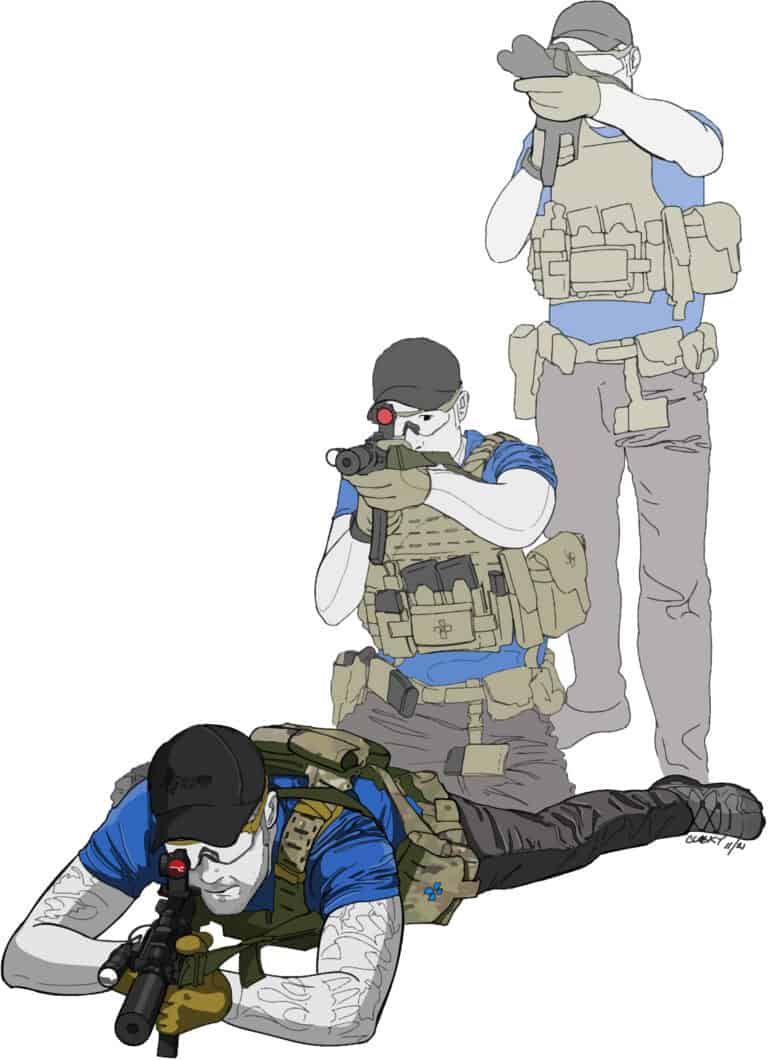
Today’s drill, The Dirty Diamond, is a rifle drill that I designed with the purpose of incorporating multiple skills into one exercise. In this case, marksmanship (always), movement (elevated heart rate), support-side shooting (shoulder transitions), and positional changes (unconventional positions).
As previously discussed, unlike other drills, The Dirty Diamond has no specific time standard associated with it, as I specifically use it as a culmination exercise in our Warrior Poet Society Rifle 3 class. This event is a team-versus-team relay race. There is no time standard; simply run each shooter in your team, individually, through each position and register the required number of hits on target before the other team.
Team events tend to offer a different type of stress than individual events, because you now have others relying on your performance, the way most units must operate daily. If you ask anyone who has played real-world team sports with guns what their greatest fear was on a mission, it’s never concern for self-preservation, but the fear of letting down your team. So by dividing the class into teams, it’s a way to introduce additional stress into the drill.
Type of Drill: Team Relay Event
Firearm/Ammo: Rifle/carbine 14 rounds if no misses (makeup shots are allowed)
Target: Rifle-rated C-Zone steel
Scoring: First team to have all shooters complete the course wins
Equipment: Minimum 50×35 yard range, shot timer, four identical barricades or stacked blue barrels, two cones, and two folding tables (or any solid platform that can be shot from)
Purpose: Movement, establishing a good platform (presentation) with the weapon, muzzle control, marksmanship accountability, support-side shooting, unconventional shooting positions, and efficient movement
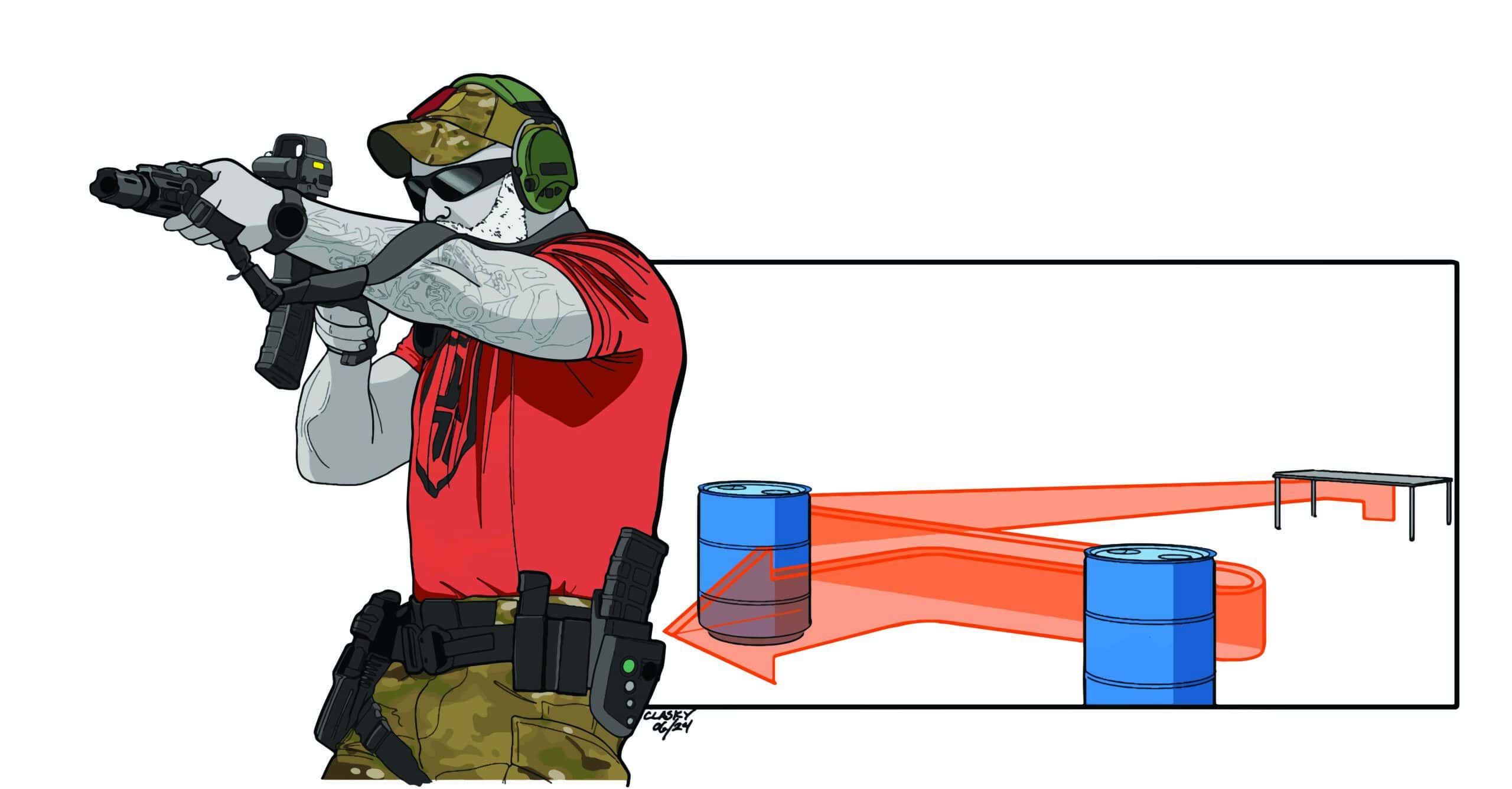
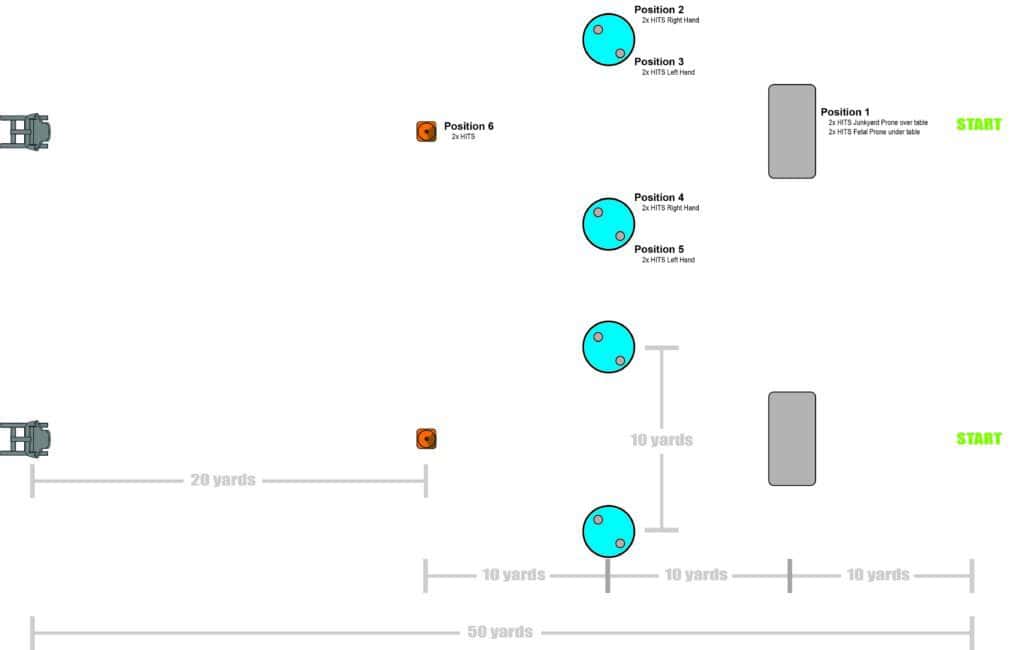
Description: Place the folding table at the 40-yard line. Barricades are placed on the 30-yard line (10 yards apart and offset on either side from the table), and the cone is centered on the folding table at the 20-yard line. Two lanes with this identical setup are required on either side of the range.
The first shooter in the relay starts at the 50-yard line. On signal (timer), the shooter advances to the table and must register 2 hits on steel from both junkyard prone (side gun over the top of the table) and fetal prone (sometime called inverted kneeling) under the table. The shooter can then advance to one of the barricades and register two hits from both sides of the barricade, shooting from the shoulder that corresponds with the side of the barricade they are shooting from (e.g., right side barricade, right shoulder).
Note that the purpose is not proper use of cover, but to use the barricades as a visual barrier to the target during the shoulder transition. The shooter then advances to the opposite barricade and repeats the process. The shooter will then advance to the 20-yard cone and register two hits. Once complete, the shooter will move back to the start point, which allows the next shooter in the relay to begin the same sequence. Text by Paul Perkerson
About the Instructor
Paul Perkerson spent six years in the United States Army, serving in a Long Range Surveillance (LRS) Company. After leaving the Army, he spent 16 years as a private military contractor supporting U.S. government operations during the Global War on Terror. He has been Training Director for Warrior Poet Society since 2020.