Less is More: The Defensive Shotgun

The shotgun is still a very popular option for personal defense in the home. With so many firearms and accessories to choose from, in this article Doug breaks down the basic requirements of a defensive shotgun from the perspective of “less is more.”
“Buy a shotgun… buy a shotgun,” he said. Well, ok… but if you’re considering using it for personal defense, skip the double-barreled models and don’t take advice on using it from Joe Biden.
The ongoing debate on whether a rifle or shotgun is superior for personal defense is probably one that will continue forever. Unfortunately, depending on where you live, your state laws may also be a consideration as you decide. I like both weapons for different reasons and recently was asked what I use for a defensive shotgun and how it’s set up.

First, I start with a pump-action 12 gauge, or a 20 gauge for smaller-framed people. The 20 gauge shotgun offers less recoil than its 12 gauge counterpart and is still effective at self-defense distances. Don’t exchange accuracy and speed for a larger caliber shotgun. Next, it needs to hold a sufficient quantity of rounds – typically 6 or more in the magazine tube. You don’t need to add any of the quad-rotating magazines or other odd after-market magazines to it… just get your shotgun with a magazine barrel that is flush with, or extends slightly past, the 18-inch barrel.
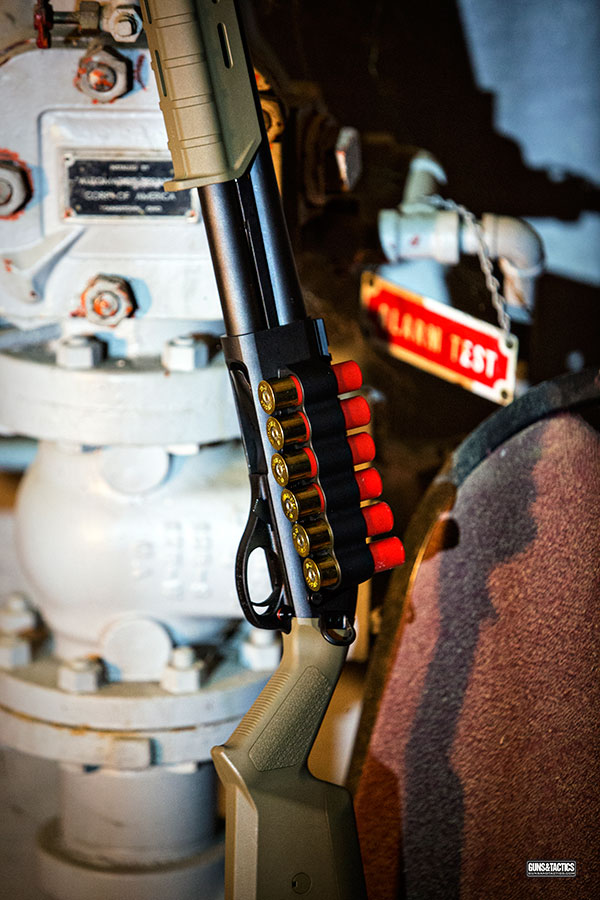
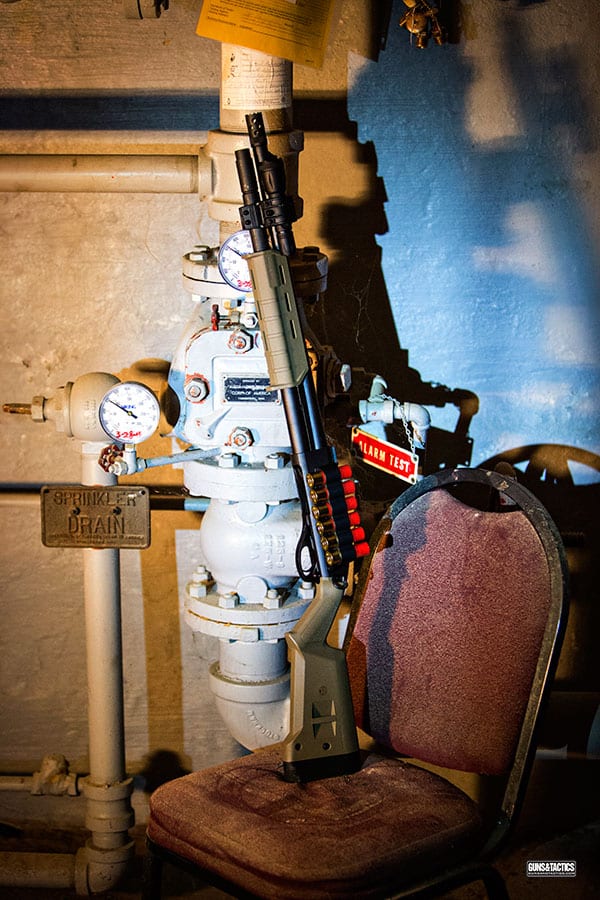
Despite the many options available for 12 gauge shotguns on the market, the Remington 870 remains king and I chose the 870 Express Tactical model with a 18.5-inch barrel, full-length magazine tube and Ghost Ring sights. I then added the Magpul stock and forend (more on that later). The Remington 11-87 police model is a great semi-automatic option for those who don’t want a pump. For me, the 870 was the clear choice because of it’s time-tested reliability and because the majority of my shotgun training has been with an 870 so I’m very familiar with it.
Now, what else should you have on your defensive shotgun?
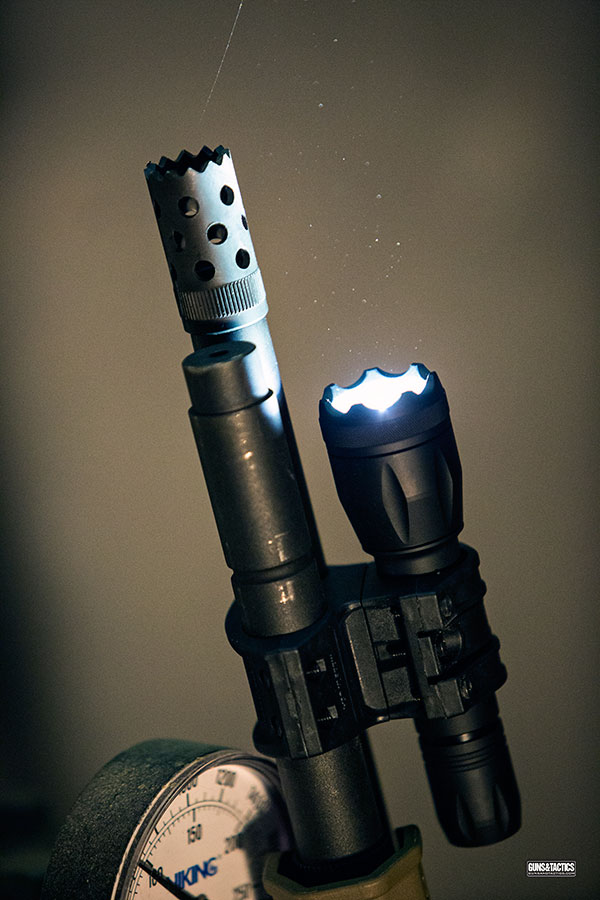
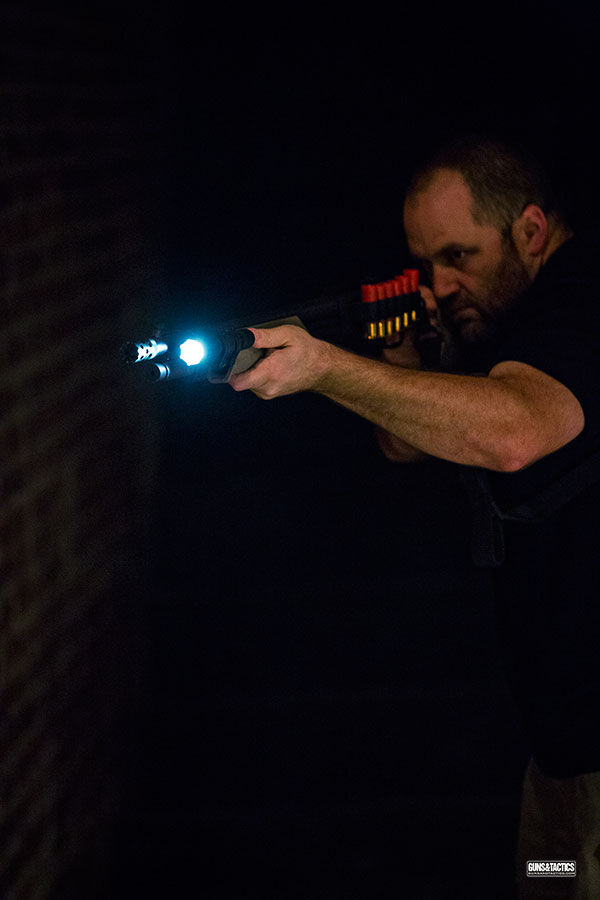
Your shotgun should accommodate some sort of side-saddle that holds 4-6 additional rounds. The side-saddle can be used to hold either additional rounds of what is already loaded in the magazine or a different kind of round to give you options, or a combination of rounds to meet your individual needs. My shotgun is loaded with 00 Buckshot and I keep a combination of more buckshot and slugs in the side saddle. Next, I add a sling which can be anything from a simple carry-strap to your favorite tactical sling. Finally, a defensive shotgun should have a good light on it that emits 400 lumens or more, and Wilson Combat sights or Ghost Ring sights. For my light, I use the 650 lumen Elzetta Bravo attached with the Elzetta ZSM mount.
A standard stock is generally best, but a shorter stock may work better for some people. I like that the Magpul stock can be set up at whatever length the shooter needs. A pistol-grip shotgun looks pretty awesome in Hollywood but in the real world accuracy and recoil management involve a shoulder stock. There are seemingly endless accessories for defensive shotguns but I generally avoid them.
“Perfection isn’t reached when there is nothing left to add, it’s reached when there is nothing left to take away.”
As with any self-defense tool, training with your shotgun is very important. Contrary to common belief, you DO have to aim with a shotgun because at defensive distances the pattern of the projectiles is only several inches in diameter. Also, as is for all firearms, malfunctions and failures happen and you must be able to effectively and efficiently clear them to keep your weapon functional. Similarly, the ability to reload efficiently, move and make use of cover, use tactics to your advantage and perform tasks like transitioning between shotgun and pistol are all important skills to have. I can never stress enough the importance of obtaining professional training and recommend that tactical parents keep up their training as regularly as they can.
Finally, as always, keep your defensive firearms loaded and locked away from little hands. There are a number of options other than a large safe for securing long guns which allow them to be safe from children while readily available for use. A couple examples of these are the TacVault and the ShotLock which work well to keep little hands away from harm. Of course, remember to mount them in a location where the muzzle is pointed in a safe direction (i.e. not in a closet pointed at an upstairs bedroom).

So, sure… go ahead and “buy a shotgun.” Just be sure to save the double-barreled models for the skeet range and take advice from a firearms instructor instead of a politician on when, where, and how to use it.